GoHighLevel vs ClickFunnels: which platform fits your actual business?
Both can build funnels, send email and manage leads. The meaningful choice is what you do after a visitor opts in: sell an offer through a focused funnel, or coordinate conversations, appointments, pipelines and client operations.
Quick verdict: GoHighLevel vs ClickFunnels
Your leads need ongoing follow-up
You manage appointment-based services, multiple communication channels, sales pipelines or clients in separate sub-accounts. HighLevel emphasizes CRM, conversations, booking, workflow automation and agency operations alongside funnels.
Typical fit: a dental office, med spa, contractor, consultant or agency trying to reduce missed follow-ups.
The sales funnel is your operating center
You build opt-in pages, order pages, upsells, courses or digital-product offers and want a funnel-led workflow. ClickFunnels 2.0 also documents contacts, CRM opportunities, automations and appointments; it is not merely a page builder. These capabilities are not necessarily included on Launch: check the live feature matrix for your chosen tier.
Typical fit: a course creator, webinar seller or offer-focused marketer.
Our editorial judgment: For a service business that depends on calling, messaging and booking leads, HighLevel is often the more natural starting point. For a business centered on product funnels and checkouts, ClickFunnels deserves a serious trial. Neither brand publishes a fair, independent, apples-to-apples conversion-rate benchmark proving that its funnels outperform the other.
Want to test HighLevel yourself? Compare official plans and start a 14-day trial, then use the seven-day test plan below. Affiliate disclosure: BizOpsEngine may earn a commission at no extra cost to you. Check trial eligibility, payment and renewal terms at checkout.
What these platforms actually have in common
Both platforms offer more than their best-known feature. HighLevel includes website and funnel building, CRM pipelines, email and SMS capabilities, scheduling, payments, courses and automation. ClickFunnels 2.0 includes funnels and checkout tools but also email marketing, workflow automations, an Opportunities CRM, appointments, communities and courses across its product offering; specific access depends on the subscription tier. The difference is therefore more about emphasis, plan limits, implementation and workflow fit than a binary list of yes/no features.
Do not assume that a feature listed on a pricing page has identical depth, usage allowance or availability in every plan. A sensible trial should replicate one of your real lead-to-sale journeys rather than compare screenshots.
GoHighLevel vs ClickFunnels pricing in 2026
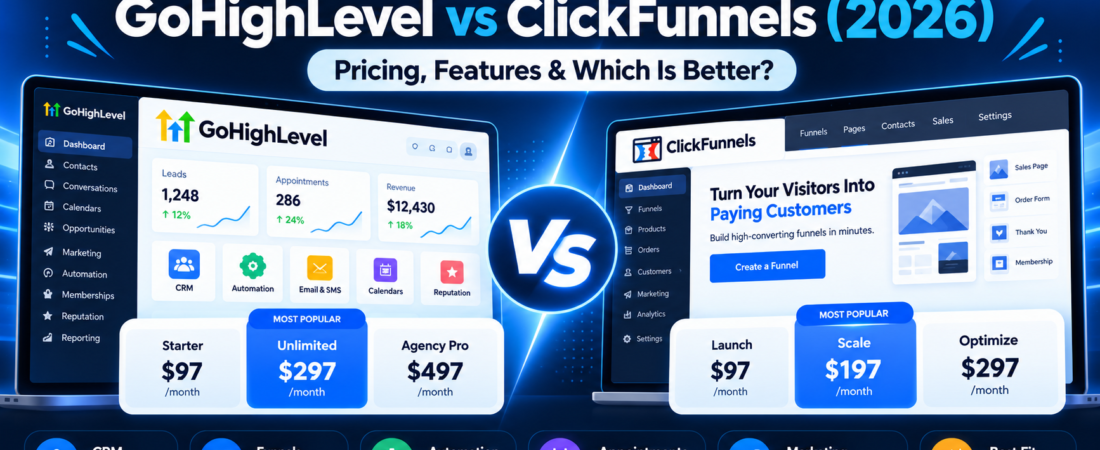
Here are the main month-to-month USD list prices shown in official vendor materials as reviewed October 28, 2026. Annual billing can reduce the equivalent monthly cost but requires a longer commitment. Taxes, promotions, payment fees and optional services are separate.
GoHighLevel plans
$970/year if billed annually
- Up to 3 sub-accounts
- Unlimited contacts and users
- Core CRM, funnel and workflow tools
$2,970/year if billed annually
- Unlimited sub-accounts
- Starter features plus basic API access
- Phone/email rebilling without markup
$4,970/year if billed annually
- Unlimited plan features plus SaaS Mode
- Automated sub-account creation
- Markup rebilling and advanced API access
ClickFunnels 2.0 plans
$970/year in its 2026 help article
- 1 brand workspace
- 2 team members; 10,000 contacts
- 50,000 emails/month
$1,970/year in its 2026 help article
- 5 brand workspaces
- 5 team members; 75,000 contacts
- 300,000 emails/month
$2,970/year in its 2026 help article
- 10 brand workspaces
- 10 team members; 150,000 contacts
- 750,000 emails/month
ClickFunnels also lists a Dominate tier at $5,997/year. Its website currently labels unlimited funnels on lower tiers as a limited-time offer. Annual promotional displays and rounded equivalent monthly amounts may differ slightly from the documented yearly invoice: confirm exact checkout totals before purchasing.
Important difference at $97/month: identical entry prices do not mean identical access. HighLevel Starter publishes three sub-accounts, unlimited contacts and core CRM/workflow tools, with metered communications. ClickFunnels Launch lists one workspace, two team members, 10,000 email contacts and 50,000 emails/month; its detailed feature matrix marks some tools—such as Calendars and Appointments—as unavailable on Launch, while automation and API entitlements vary by tier. If appointments or multi-step automation are essential, inspect the feature matrix before comparing only the $97 price.
| Plan | Monthly USD | Business accounts / workspaces | Contacts / team | Published email allowance |
|---|---|---|---|---|
| HighLevel Starter | $97 | 3 sub-accounts | Unlimited contacts and users | LC Email billed by usage |
| HighLevel Unlimited | $297 | Unlimited sub-accounts | Unlimited contacts and users | LC Email billed by usage |
| HighLevel Agency Pro | $497 | Unlimited sub-accounts | Unlimited contacts and users | LC Email billed by usage |
| ClickFunnels Launch | $97 | 1 workspace | 10k contacts / 2 users | 50k emails per month |
| ClickFunnels Scale | $197 | 5 workspaces | 75k contacts / 5 users | 300k emails per month |
| ClickFunnels Optimize | $297 | 10 workspaces | 150k contacts / 10 users | 750k emails per month |
Mobile readers: swipe horizontally inside the table to see the remaining columns. The left column stays visible. “Unlimited contacts” is not the same as unlimited free sends. Each company’s “workspace” terminology, roles and plan entitlements differ.
Primary sources: HighLevel official pricing, ClickFunnels official pricing, and ClickFunnels’ April 2026 pricing explanation.
Funnels, CRM, automation, email and appointments
The question is not whether a product has a button labeled “CRM” or “Automation.” It is whether the sequence of events your team needs can be built, monitored and maintained within your plan.
| Capability | GoHighLevel | ClickFunnels 2.0 | Practical buying test |
|---|---|---|---|
| Landing pages & funnels | Website and funnel builder included among core features. | Funnel editor, landing pages, checkout, upsells and A/B testing are central to its product. | Build the same opt-in, offer and thank-you sequence. |
| CRM & deal stages | Contacts, pipelines, opportunities and unified conversations. | Contacts, Opportunities app and configurable pipeline stages. | Assign a lead, advance a deal and report the outcome. |
| Follow-up automation | Core workflows linked to lead, messaging and sales events. | Quick actions, workflows and advanced automation are documented, but some levels are excluded from lower tiers. | Confirm which automations your subscription actually allows; test reply-aware follow-ups. |
| Booking & calendars | Booking calendars are included among HighLevel core features. | Calendars and Appointments exist in ClickFunnels 2.0, but its pricing matrix shows they are not included on Launch; plan access varies. | Book, reschedule and suppress follow-ups after booking in the specific plan you would buy. |
| LC Email available; usage billed separately at published rates. | Email marketing with published per-plan contact and monthly sending allowances. | Verify deliverability, sender DNS and actual send volume. | |
| SMS and calling | Native phone/SMS workflow options with metered usage and carrier rules. | Message Hub and communication options are listed; validate phone/SMS channel availability and costs for your plan and region. | Run a consented missed-call or lead-response scenario. |
| Courses and communities | Courses and communities among platform features. | Courses, communities and related tools with tier-based course counts. | Test enrollment, access rules and recurring offers. |
| Multiple client businesses | Sub-accounts: 3 on Starter; unlimited on higher agency plans. | Workspaces: 1, 5 or 10 on the first three published plans. | Model your next 12 months of client locations. |
| Reselling / SaaS | Agency Pro explicitly includes SaaS Mode and marked-up rebilling. | Multiple workspaces and business tools; not a like-for-like promise of HighLevel SaaS Mode. | Compare provisioning, permissions, support and invoicing. |
| API / integrations | Basic and advanced API capabilities vary by tier. | API/webhook availability and custom code vary by tier. | Check the exact trigger, endpoint and plan entitlement. |
Mobile readers: swipe horizontally inside the table for all product and buying-test columns. Comparison summarizes public feature descriptions rather than claiming parity or a measured winner. See each vendor’s official pricing and help center for role-level restrictions, country support and changes.
Funnels & selling online
ClickFunnels presents the buyer journey as a funnel: attract visitors, capture leads, sell with smart checkouts and follow-up offers, and deliver access to products or courses. That positioning can be compelling when your weekly work consists mainly of offers, funnel experiments and digital-product fulfillment. HighLevel can also host funnels and collect payments, but its broader operational toolkit may be more than you need for a single checkout.
CRM & lead management
HighLevel is built around tracking contacts, conversations, appointments and pipeline stages across ongoing interactions. It can be attractive when leads arrive by phone, form, chat or advertising and need staff ownership. ClickFunnels also supports pipelines through its Opportunities app. A fair comparison is therefore to test how easily each platform moves a lead from opt-in to assigned opportunity to real follow-up, rather than dismissing ClickFunnels as having no CRM.
Automations & messaging
Both vendors document workflow automation. HighLevel is often worth testing for multi-channel service follow-up; ClickFunnels may be attractive when automation centers on a funnel step, purchase, tag or course enrollment. Your actual plan, sending infrastructure, permissions and channel availability determine the usable workflow. For US SMS, review consent and applicable carrier registration before any live campaign.
What can cost extra beyond the subscription?
A $97/month plan can be excellent value or a poor fit depending on your total operating costs. Compare subscription price plus communication usage, contact allowances, payment processing, domains, optional AI products, integrations and your team’s setup time.
HighLevel: usage-based charges to budget
- LC Email: $0.675 per 1,000 emails at the published rate, with separately billed forwarding or verification where applicable.
- Phone numbers: official October 2026 guide lists US/Canada local numbers at $1.15/month and toll-free at $2.15/month.
- US/Canada SMS: published base outbound and inbound rate of $0.00747 per segment, plus applicable carrier fees and registrations.
- AI and add-ons: official AI Employee Growth is $50/month per enabled location, and Unlimited is $97/month per enabled location (subject to product rules and fair use). WhatsApp, dedicated email IPs and other services can add costs.
Rates depend on country, channel, configuration and time. “Unlimited contacts” does not mean phone, SMS, email or AI usage is free. An AI subscription does not necessarily cover the telephone portion of AI voice calls.
ClickFunnels: limits and external expenses
- Contacts & sends: Launch, Scale and Optimize publish different contact, user, workspace and email/month allowances.
- Sending setup: custom email sending requires domain verification; external SMTP is optional and may have a separate provider bill.
- Payments: calculate your actual processor and transaction fees; these are not removed by a funnel subscription.
- Operations: check charges or tier changes for your chosen integrations, appointment workflow, domains and advanced features.
ClickFunnels’ official app/help documents describe email, workflows, appointments and CRM features, but exact availability and usage rules should be checked for the plan you buy.
Illustrative calculation — not a quote: HighLevel Starter ($97/month) + 20,000 LC emails at $0.675 per 1,000 ($13.50) + one US local number ($1.15) = $111.65/month, before SMS, calls, carrier pass-through charges, A2P registration, taxes, optional add-ons and other activity. This simple example demonstrates why the monthly plan sticker price is only a starting point.
Official cost references: LC Email pricing, LC Phone pricing and billing, and HighLevel add-on and AI pricing.
A realistic total-cost checklist
Before choosing either plan, write down six numbers: (1) subscription, (2) email sending, (3) calls/SMS and phone numbers, (4) AI or other paid apps, (5) payment processor/integration charges, and (6) staff hours required to build and maintain the workflow. For ClickFunnels, also note when your contact or email allowance would force an upgrade. For HighLevel, calculate metered activity even though contacts are unlimited.
Useful comparison: If you have 20,000 email sends each month, HighLevel LC Email’s published sending rate makes that $13.50 before other usage. ClickFunnels Launch lists up to 50,000 emails/month within its plan allowance, but that is not a promise that every related email, integration, or overage cost is included. The two products have different billing structures, so compare a full campaign—not a single line item.
Why an “unlimited” claim can be misunderstood
HighLevel’s published unlimited contacts and users apply to the plan’s contact/user allowance—not every communication transaction, AI action or third-party service. ClickFunnels’ pricing page, meanwhile, separately lists contact and email allowances and describes its unlimited-funnels promotion as limited-time. Read the unit next to every “unlimited” claim. It is rarely a universal statement about every type of usage.
Best fit by business model
Local service business
Leads need callbacks, appointment confirmations, pipeline stages and timely team handoffs. Evaluate HighLevel first—but test texting, booking and compliance in your location.
Course or funnel-led seller
Revenue relies on opt-in pages, a compelling checkout, course access and offer experiments. Compare ClickFunnels’ funnel and fulfillment workflow before choosing.
Multi-client agency
Separate client workspaces, permissions, reporting, follow-up and possibly SaaS resale matter. HighLevel’s Unlimited and Agency Pro tiers are especially relevant.
Coach or consultant
Appointment-heavy operations may favor HighLevel; course/checkout-led offers may favor ClickFunnels. Test the dominant customer journey, not an abstract feature checklist.
Online store or webinar seller
Try a complete campaign from landing page to payment and follow-up. Look at checkout configuration, email and segmentation needs and external commerce systems.
Very simple requirements
If you only need a contact form, a basic newsletter and no complex funnel or pipeline, neither $97 starting plan may be necessary. Avoid buying a platform you will not use.
Scenario A: home-service business with missed leads
A plumbing company receives calls and quote requests after hours. The owner wants a new lead record, notification to the right staff member, appointment booking, and reminders that stop when the customer replies. HighLevel’s combination of conversations, workflows and pipelines makes it a natural platform to trial. The team must still check phone coverage, consent and the cost of each call or text.
Scenario B: creator selling a digital course
A creator runs a lead magnet, a webinar registration, a sales page, checkout and a course area. ClickFunnels’ funnel-first editor, checkout, courses and offer journey may fit especially well. HighLevel is still an alternative; test course access, payment steps, reporting and the full customer experience before migrating.
Scenario C: agency managing ten client locations
An agency wants separate client access, lead pipelines and reporting for ten businesses. HighLevel Unlimited publishes unlimited sub-accounts; ClickFunnels Optimize lists ten workspaces. These are not guaranteed to have identical tenant isolation, admin roles or agency rebilling options. The choice depends on the exact scope of each client, team permissions, support expectations and whether agency SaaS provisioning or rebilling is required—not on workspace count alone.
Switching platforms? Protect what already works
A tool migration can affect active funnels, email authentication, tracking, payment links and staff routines. Before canceling the current software, inventory your forms, funnels, domains, sequences, checkout products, appointment links, tags and CRM fields. Export data where available; do not assume every automation or historical metric is portable.
- Audit the current customer journey. List every form, purchase, booking and follow-up trigger.
- Build a parallel test. Recreate one high-value funnel or service workflow in the candidate platform.
- Verify measurement. Keep UTM tracking, conversion definitions, consent records and analytics comparable.
- Check delivery and billing. Verify email DNS, phone registrations, recurring payments, taxes and add-ons.
- Switch in phases. Test redirects, contact imports, unsubscribes and team permissions before shutting down the old system.
Measurement warning: A higher or lower dashboard conversion percentage after migration does not by itself prove improved or worse page performance. Platforms can define visitors, sessions, unique leads and attribution differently. Compare first-party conversion events, the same traffic window and the same offer before drawing conclusions.
A seven-day test plan before you commit
HighLevel’s official pricing page advertises a 14-day free trial, subject to its checkout terms. ClickFunnels currently offers a free-trial entry point too; check the duration and card/renewal terms directly at checkout. Use trial time to test one complete real-world workflow.
- Day 1 — Map the funnel. Identify visitor source, offer, form, appointment or payment and follow-up goal.
- Day 2 — Build the pages. Create a mobile-friendly lead or sales flow on your own domain/test subdomain.
- Day 3 — Configure contacts. Import a small, permissioned test set and validate fields, tags and pipeline stages.
- Day 4 — Automate responsibly. Trigger a welcome email, staff alert and reply/booking-dependent next step.
- Day 5 — Test the sale. Check payment or booking completion, receipt and downstream fulfillment.
- Day 6 — Audit the bill. Review contact limits, usage reports, SMS/email rates, domains and integration costs.
- Day 7 — Decide with evidence. Record setup time, failed steps, team usability, real cost and future workload.
Do not send unsolicited test marketing to real contacts. Use permissioned test records, opt-out controls and the appropriate country-specific privacy and carrier rules.
A repeatable buying scorecard (instead of an arbitrary winner)
Run the same test tasks in both accounts and score each item from 0 to 2: 0 = not achievable within the plan, 1 = achievable with an extra tool or significant workaround, 2 = completed reliably in your chosen plan. This is a decision worksheet, not a published benchmark or a claim that either vendor already won.
Give each platform a score out of 12, then choose based on your highest-priority workflow and total cost. An essential task scoring zero should outweigh a glossy feature list.
Build an opt-in or purchase flow, connect your domain and confirm form data arrives.
Assign an owner, move pipeline stages and find the full contact history.
Trigger a consented email or message; stop or branch after a reply/booking.
Test an appointment or purchase, confirmation and fulfillment.
List base price, sending, add-ons, provider charges and plan upgrades.
Have a colleague repeat a key task using realistic permissions and training.
GoHighLevel vs ClickFunnels FAQs
Is GoHighLevel cheaper than ClickFunnels in 2026?
Both advertise entry plans at $97/month. Mid-tier and advanced plans differ: HighLevel Unlimited is $297/month and Agency Pro is $497/month, while ClickFunnels Scale is $197/month and Optimize is $297/month. Plan limits and usage charges are not identical, so compare the full bill for your use case rather than monthly sticker prices.
Does ClickFunnels 2.0 have a CRM and automations?
Yes. ClickFunnels documents an Opportunities CRM with pipeline stages, email marketing and automation workflows in the platform. Launch does not include every Calendar, Appointments or workflow capability shown for higher tiers; available features and communication allowances vary by plan; test the exact sequence you need.
Can GoHighLevel replace ClickFunnels?
For some businesses it can replace funnel building and much of the follow-up stack. That is not a guarantee of a seamless migration or equal checkout/funnel behavior. Rebuild a representative funnel, verify analytics and email settings, and test before canceling ClickFunnels.
Which platform is better for agencies?
HighLevel is particularly relevant to agencies because it publishes unlimited sub-accounts on Unlimited and Agency Pro and adds SaaS Mode on Agency Pro. ClickFunnels supports multiple workspaces on Scale and Optimize. Compare client permissions, required apps, provisioning and billing before deciding.
Which is better for course creators and digital products?
ClickFunnels is a strong candidate for creators focused on funnels, checkout and course delivery; it includes course/community allowances by plan. HighLevel also supports courses and communities. Test learner access, checkout experience, email workflow and your actual course configuration in both.
Does HighLevel really include unlimited contacts?
Its official pricing lists unlimited contacts and users across the three main plans. Communication activities—including LC Email, SMS, calls and some AI products—can still incur separate charges or limits. “Unlimited contacts” is not “unlimited everything.”
Does ClickFunnels include unlimited funnels?
Its current pricing page advertises unlimited funnels on Launch, Scale and Optimize, while marking the offer as limited-time. Check the live offer and your agreement before treating that as a permanent entitlement.
Are there hidden fees on either platform?
HighLevel publishes metered phone, SMS, email and optional add-on pricing; ClickFunnels publishes contacts, email allowances and tier differences, while payment gateways, inbox hosting, optional integrations and external services may add costs. Ask what you will actually pay for your country, channels, volume and subscription.
Do I need both GoHighLevel and ClickFunnels?
Not necessarily. Many core functions overlap. Keeping both may be justified if a proven funnel cannot yet be reproduced or your team relies on distinct systems, but duplicated subscription and integration costs deserve a clear business case. Test the process before consolidating.
Which should you choose?
Start with HighLevel if you are trying to centralize lead capture, multi-channel follow-up, bookings, pipelines or multiple client accounts. Start with ClickFunnels if your main job is building and refining sales funnels, checkout offers and digital-product journeys. Choose neither yet if your business does not have a defined workflow or if simpler tools already solve the problem at lower cost.
When comparing software, the best question is not “Which has more features?” It is: “Which lets my team reliably complete our most important customer journey, within the real monthly budget?”
Compare the official plans, then test your workflow
HighLevel is worth evaluating for CRM-led lead management and multi-client operations. ClickFunnels is worth evaluating when offers, checkout and funnel execution are the priority. Review both vendors’ current terms before entering a payment method.
HighLevel affiliate link. A 14-day trial is advertised on its official pricing page; review eligibility, required payment information, automatic renewal and usage fees at checkout. BizOpsEngine may earn a referral commission.
Go deeper: Read our GoHighLevel Pricing Guide 2026 for the detailed HighLevel cost breakdown, or follow our GoHighLevel Setup for Small Business walkthrough to build a practical first workflow. You can also explore our free GoHighLevel Quick-Start Checklist on BizOpsEngine.
Official sources and how this guide was prepared
This independent educational comparison was drafted with AI assistance and fact-checked against vendors’ published 2026 pricing and support documentation; it does not claim first-hand testing of two paid production accounts. Feature descriptions are sourced from public materials; scenario recommendations are editorial interpretations, not measured product speed, conversion rates or customer outcomes.
How to use these sources: Start with each vendor’s official pricing matrix for current tiers, then confirm support-doc details for the exact workflow you need. The official pricing pages are authoritative for offers but also promotional; compare their features and restrictions side by side rather than accepting either vendor’s “best” claims at face value.
- HighLevel — Official plans, feature lists, trial and optional add-ons
- ClickFunnels — Official plans, workspaces, contacts, email limits and product features
- ClickFunnels — ClickFunnels 2.0 Pricing, April 15, 2026
- HighLevel — LC Email system and pricing
- HighLevel — Phone system pricing and billing
- HighLevel — AI and add-on pricing, wallets and rebilling
- ClickFunnels — How to create and manage CRM pipelines
- ClickFunnels — Funnel-step automations
- ClickFunnels — SMTP setup and email delivery options
- HighLevel — A2P brand registration guidance
Editorial limitations: We did not run a simultaneous paid account benchmark, audit proprietary customer data or verify a checkout for every region and tax jurisdiction. We therefore avoid claims such as “X converts 2× better,” “zero extra fees,” or “guaranteed results.” Both products change frequently; use the official links before a purchase decision. Reseller, SMS, AI and integration features can depend on your plan and country.